Random Forest
Random Forest is a robust and versatile machine learning algorithm that excels in both classification and regression tasks. By constructing a multitude of decision trees during training and outputting the average prediction of the individual trees, Random Forest reduces overfitting and enhances predictive accuracy. This ensemble method leverages the power of many models, combining their strengths to deliver a highly accurate and stable predictive performance. Its inherent ability to handle large datasets with higher dimensionality and its resilience to noisy data make Random Forest an excellent choice for a wide range of applications, from medical diagnostics to financial forecasting.
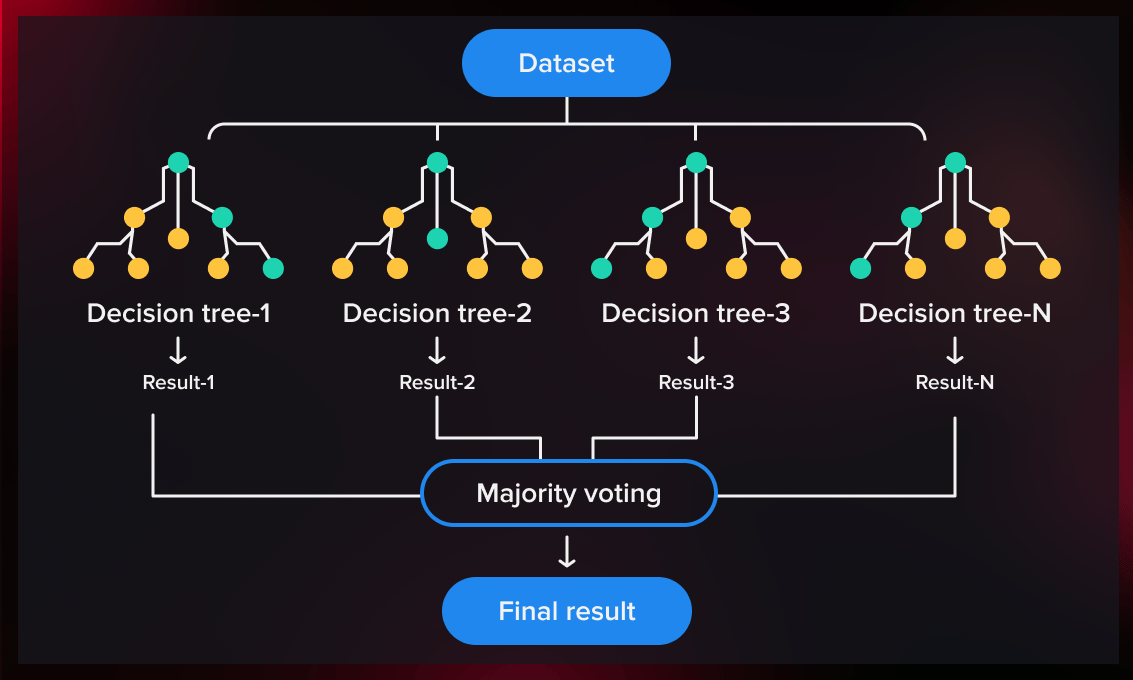
Many advantages
Random Forest offers several advantages that make it a popular choice in machine learning. Its ability to handle both classification and regression tasks with high accuracy is one of its main strengths. The algorithm reduces overfitting by averaging the results of multiple decision trees, providing robust and reliable predictions. It also excels in handling large datasets with high dimensionality and is capable of managing missing data effectively. Additionally, Random Forest can assess the importance of different features in determining outcomes, aiding in feature selection and model interpretability. Its flexibility and resilience to noise further enhance its performance across diverse applications.
Limitations
Despite its many advantages, Random Forest has some disadvantages. It can be computationally intensive and memory-consuming, especially with a large number of trees and features. The algorithm may also produce less interpretable models compared to simpler algorithms, making it difficult to understand individual predictions. Additionally, while it reduces overfitting, it can still struggle with very noisy data and may require significant tuning to achieve optimal performance.
"Random Forest is a versatile and robust algorithm that shines in a wide range of applications, providing excellent performance with minimal tuning."
Dr. Leo Breiman, Statistician and Creator of the Random Forest Algorithm.